Why I Chose the Agroecology Course:
What if the future of agriculture depends not only on producing more food, but also on restoring biodiversity, improving soil health, strengthening farmers’ livelihoods, conserving traditional knowledge, and building resilient local food systems?
This question became increasingly important to me during my professional journey in agriculture.
As an agriculture professional working with farmers in Koraput, Odisha, I have spent years engaging with farming communities, traditional crops, millets, indigenous seeds, sustainable agriculture, and rural livelihoods. The more I worked with farmers, the more I realised that agriculture cannot be understood only through crop production, productivity, or the adoption of individual technologies.
Agriculture is connected to ecology, culture, nutrition, markets, community institutions, climate, and public policy. Changes in one part of the system affect the others.
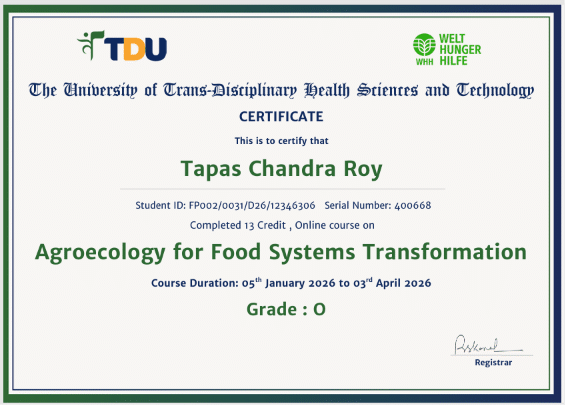
In 2026, I had the opportunity to participate in the Agroecology for Food Systems Transformation Course, organised by Welthungerhilfe and Sambhaav Trust under the Food Systems Multiversity platform, with certification by the University of Trans-Disciplinary Health Sciences and Technology (TDU), Bengaluru.
The experience was deeply enriching. It encouraged me to look beyond conventional agricultural practices and examine how food systems can be transformed through ecological principles, farmer-led innovations, collective action, and context-specific solutions.
For anyone interested in sustainable agriculture, agroecology, food systems, rural development, or climate-resilient farming, this is a learning opportunity worth exploring.
What Is the Agroecology for Food Systems Transformation Course?
The Agroecology for Food Systems Transformation Course is a multidisciplinary learning programme designed to help participants understand and apply agroecological principles to real-world food systems.
The programme brings together different perspectives from practitioners, scientists, farmers, and people working towards more sustainable and equitable food systems.
One of its most valuable features is its emphasis on connecting conceptual learning with practical experience. Instead of viewing farming as an isolated activity, the course encourages participants to explore the relationships between agricultural production, natural resources, communities, markets, culture, and institutions.
The course is offered through the Food Systems Multiversity platform, with Welthungerhilfe and Sambhaav Trust as the organising institutions and TDU Bengaluru as the certifying university.
For me, this approach was particularly relevant because many of the challenges faced by farming communities in tribal regions cannot be solved through a single agricultural intervention. They require an integrated understanding of local ecosystems, indigenous knowledge, community participation, and economic opportunities.
My Biggest Learning: Agroecology Is More Than Organic Farming
Before exploring agroecology in greater depth, it is easy to associate it primarily with organic farming, natural inputs, or avoiding synthetic chemicals.
These are important considerations, but agroecology has a much broader scope.
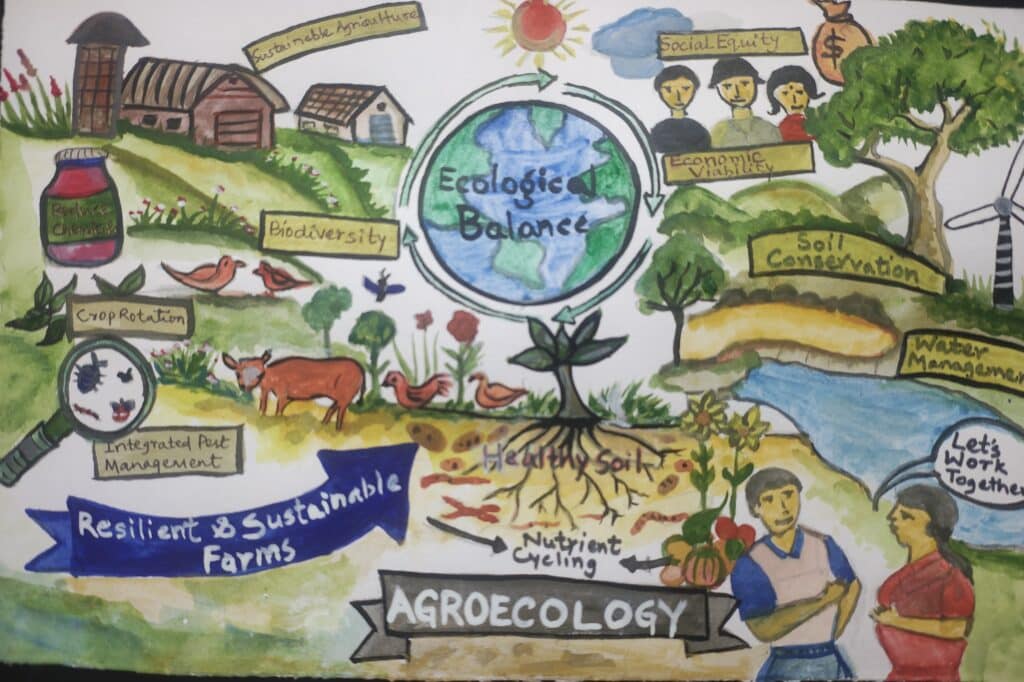
It involves understanding how agricultural systems function as living ecosystems while recognising the social, economic, political, and cultural dimensions of food.
Some of the important themes that shaped my learning included:
- Biodiversity and seed sovereignty: Conserving indigenous seeds, traditional crop varieties, and genetic diversity.
- Ecological farming: Improving soil health, nutrient cycling, and the use of locally available biological resources.
- Climate resilience: Understanding local weather patterns, rainfall, landscapes, and the ability of communities to respond to climate variability.
- Traditional knowledge: Recognising the contribution of farmers and Indigenous communities to the conservation of agricultural biodiversity.
- Farmer-centred markets: Connecting sustainable production with fair prices, reliable procurement, and viable livelihoods.
- Food culture and nutrition: Understanding the relationship between local crops, traditional recipes, dietary diversity, and food security.
The course helped me appreciate that agroecology is not a standard package of practices that can be copied from one location to another. It is a process of learning from ecosystems and communities, adapting to local conditions, and developing solutions that work for farmers.
Bringing the Learning Back to Koraput, Odisha
For me, the real value of any training programme lies in how its lessons can be applied in the field.
Koraput is known for its rich agricultural biodiversity, traditional farming knowledge, indigenous rice varieties, millets, and close connections between food, culture, and community life.
My work with farmers and initiatives supporting millets and forgotten foods has repeatedly shown me the importance of conserving traditional crops while creating viable livelihood opportunities.
The agroecology course strengthened my understanding of why these initiatives should be approached as interconnected components of a larger food system.
For example, promoting millets should not be limited to increasing the area under cultivation. A stronger approach also considers:
- Conservation and community management of indigenous millet seeds.
- Ecologically appropriate cultivation and locally available bio-inputs.
- Women’s knowledge, participation, and leadership in farming and food processing.
- Traditional recipes and the nutritional value of local foods.
- Farmer collectives, processing enterprises, and market access.
- Consumer awareness and the revival of local food cultures.
This integrated approach connects conservation, cultivation, consumption, and commercialisation.
It also reinforces the importance of working with farmers as knowledge holders and active participants in food systems transformation, rather than treating them merely as recipients of agricultural advice.
The course has encouraged me to think more systematically about how these principles can inform field-level extension, farmer institutions, agroecological models, and local food enterprises.
Agroecology Is Also About Markets and Livelihoods
An important lesson from my experience is that sustainable farming must also be economically viable.
Farmers cannot be expected to conserve traditional varieties, adopt ecological practices, or maintain diverse farming systems if doing so places their livelihoods at risk.
Agroecological transformation therefore requires more than changes at the farm level. It also requires supportive institutions, appropriate market arrangements, collective enterprises, and recognition of the value created by farmers.
The Wayanad experience illustrated how seed conservation, local production systems, farmer collectives, and market connections can complement one another.
This perspective is equally relevant for millets, indigenous rice, pulses, and other traditional crops in Odisha.
Farmer Producer Organisations, self-help groups, local processing units, community seed banks, and small food enterprises can all contribute to more resilient local food systems when they are appropriately supported.
For young professionals and aspiring entrepreneurs, this is an important area to explore: agroecology can create opportunities not only in farming, but also in processing, value addition, advisory services, ecological inputs, local food businesses, and market development.
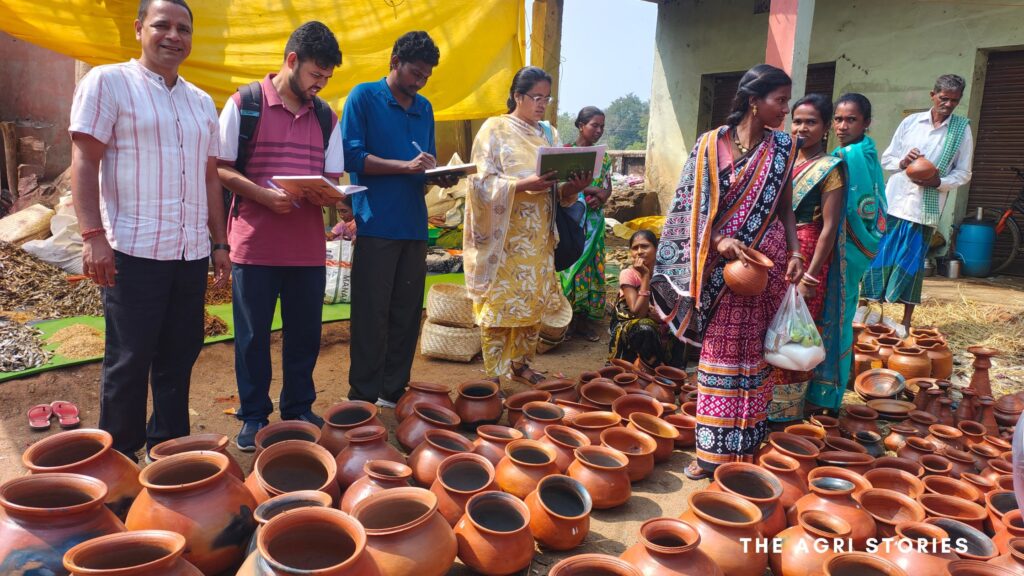
Related Post: A Walk Through Local Weekly Market: A Living Example of Agroecology in Action
Who Should Consider This Course?
Based on my experience, I would encourage the following groups to explore the programme:
Agriculture professionals and extension workers: To develop a broader understanding of farming beyond conventional production-oriented approaches.
Students and graduates: To explore emerging opportunities in sustainable agriculture, food systems, rural development, and environmental work.
NGO and development-sector professionals: To strengthen their understanding of community-led initiatives, biodiversity conservation, and sustainable livelihoods.
Researchers and educators: To connect scientific perspectives with farmers’ knowledge and practical field realities.
Farmers, entrepreneurs, and food-system practitioners: To understand how ecological production, local resources, and farmer-centred markets can work together.
The programme is particularly valuable for people willing to question existing assumptions, learn from diverse perspectives, and connect classroom learning with field realities.
You do not need to be an agroecology expert before applying. According to the announced eligibility criteria, graduates from any academic background can apply. What matters is your willingness to engage seriously with the learning process.
Course Details: The Upcoming 2026–27 Batch
If you are interested in participating, the following information is based on the announcement shared by the Food Systems Multiversity team.
| Particulars | Details |
| Course | Agroecology for Food Systems Transformation |
| Duration | 23 November 2026 – 19 February 2027 |
| Length | 13 weeks |
| Organisers | Welthungerhilfe and Sambhaav Trust |
| Certifying institution | TDU, Bengaluru |
| Eligibility | Graduates from any background |
| Online sessions | Monday–Friday, 9:00–11:00 am and 11:30 am–1:30 pm |
| Course fee | No course fee |
| Contribution | ₹6,000, reimbursable against local fieldwork expenses after successful completion, subject to the stated conditions |
| Application deadline | 9 November 2026 |
Important: Participants are responsible for their fieldwork expenses, as well as certification and academic credit costs. Review the official brochure carefully for the complete requirements, reimbursement conditions, attendance expectations, and any additional expenses before applying.
Useful links:
- Apply for the course
- Read the official course brochure
- Visit Food Systems Multiversity
- Follow Food Systems Multiversity on Instagram
- Follow Food Systems Multiversity on LinkedIn
For queries, the announcement lists [email protected] and WhatsApp-only contact numbers +91 79779 05741 and +91 87419 27131.
My Advice to Future Participants
If you are planning to join this course, I would suggest approaching it with curiosity and a willingness to learn beyond your existing professional boundaries.
Do not treat it merely as a certificate programme. Engage actively in the discussions, listen carefully to farmers and practitioners, document your observations, and reflect on how the lessons relate to your own region.
Whenever possible, connect the learning with a real farming community, landscape, or food-system challenge.
Ask yourself: What are the major ecological challenges in my region? Which traditional crops and knowledge systems are at risk? How can farmers improve their livelihoods without degrading their natural resources? What changes are needed in markets, institutions, and public policy?
These questions can turn a course into a starting point for long-term professional and community-level action.
Also, plan your schedule carefully. The announced programme includes weekday online sessions and fieldwork, so participants should understand the time commitment and budget for the associated expenses.
Conclusion: Transforming Food Systems Begins with a Change in Perspective
My experience with the Agroecology for Food Systems Transformation Course in 2026 has reinforced my belief that the future of agriculture depends on integrating ecological sustainability with farmer livelihoods, biodiversity conservation, local knowledge, and resilient food systems.
For me, one of the most important lessons is that solutions already exist within many farming communities. Indigenous seeds, traditional crops, local food cultures, ecological practices, and collective institutions provide valuable foundations for transformation. Our responsibility is to understand, strengthen, and connect these resources with appropriate science, policy, and market opportunities.
The course helped me look at agriculture through a wider lens—from individual farms to entire food systems, and from crop production to the relationships between people, nature, and livelihoods.
Would I recommend exploring this course? Yes, particularly for people who want to understand agriculture as a living, interconnected system and are willing to translate learning into practice.
If you are an agriculture professional, student, researcher, development practitioner, or someone passionate about sustainable food systems, consider exploring this opportunity.
The transformation of food systems does not begin with a single technology or intervention. It begins with a willingness to learn, collaborate, and see agriculture differently.
Author: Tapas Chandra Roy, Block Agriculture Officer, DA&FE, Govt. of Odisha. Documenting and disseminating success stories of farmers to inspire millions of farmers across India.
If you wish to submit any inspiring stories of farmers, you can send them to this email address: [email protected]. Please ensure your submission includes a Word document and high-resolution photographs.