
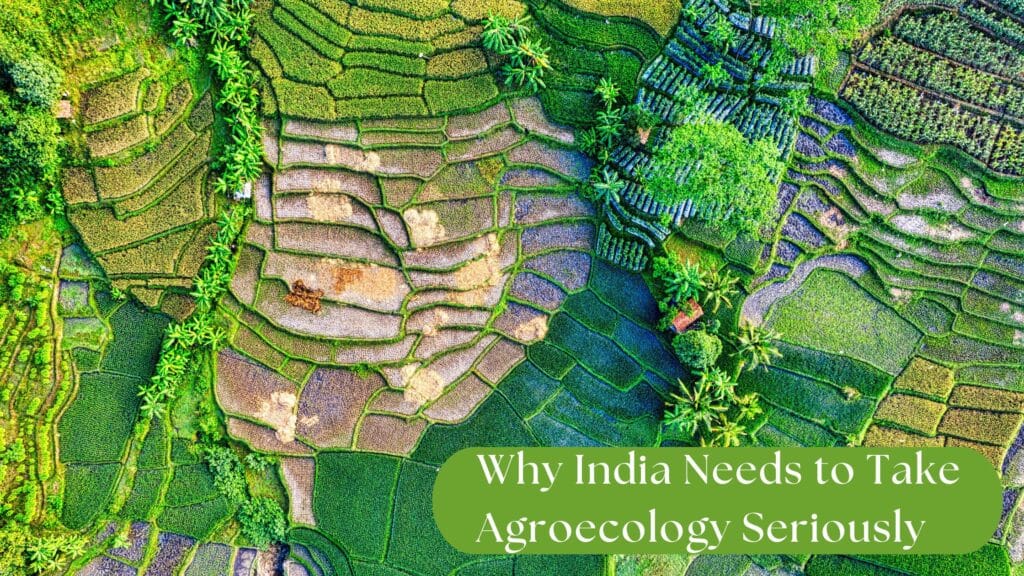
Standing in the red soils of Koraput, I watch a tribal smallholder carefully thread a row of arhar between his ragi. Nothing about this looks scientific. There is no soil sensor, no drone, no lab report in sight. And yet, this is precision agriculture in its oldest and most tested form.
It forces a question I keep returning to:
Are we merely producing food in India or are we designing food systems that can last?
India stands at a genuine crossroads. Decades of Green Revolution-led intensification gave us food security we should never take for granted. But the same model is now running into its own limits — degraded soils, stressed aquifers, climate shocks, and farm incomes that refuse to keep pace with input costs.
The fix isn’t another input subsidy tweak. It is a systemic redesign. That redesign has a name: Agroecology.
What Is Agroecology and Why It Matters Now?
Agroecology is not a farming technique. It is a science, a set of practices, and increasingly a policy movement that treats ecology, economics, and equity as one connected system rather than three separate departments.
The Food and Agriculture Organization (FAO) formalised this thinking in its 10 Elements of Agroecology, endorsed by FAO’s 197 member states in 2019: diversity, co-creation and sharing of knowledge, synergies, efficiency, recycling, resilience, human and social values, culture and food traditions, responsible governance, and a circular and solidarity economy. It is the closest thing the world has to a shared definition and it deliberately refuses to reduce agroecology to “chemical-free farming.”
That distinction matters, because in India’s policy conversation, agroecology keeps getting flattened into a single question, organic or natural? When the real question is about redesigning the system itself: soil, water, seed, market, and knowledge, together.
Data: Why Agroecology Is No Longer Optional
Here is what the numbers actually say about the system we are running today.
| Stress Point | What the Data Shows | Source |
| Soil degradation | 97.85 million hectares — 29.77% of India’s geographical area is degraded | ISRO/Space Applications Centre, Desertification and Land Degradation Atlas of India, 2021 (2018-19 data) |
| Water dependence | Agriculture accounts for roughly 90% of India’s total freshwater withdrawals | FAO AQUASTAT / World Bank data |
| Input dependence | Fertiliser subsidy stands at ~₹1.68 lakh crore (FY 2025-26 Budget Estimate); the all-India NPK use ratio has skewed to 10.9 : 4.4 : 1 against an ideal 4:2:1, and nutrient-use efficiency is estimated at only 35-40% | Union Budget documents; Department of Fertilizers |
| Farm structure | Small and marginal holdings (under 2 hectares) make up ~86% of India’s operational holdings nationally — and over 90% in Odisha | Agriculture Census 2015-16 |
| Climate exposure | Areas facing high-to-very-high soil erosion risk are projected to rise from 35.3% to 40.3% of the country by century-end due to climate change | ISRO Land Degradation Atlas |
Read together, this is not five unrelated problems. It is one system — heavily input-dependent, water-stressed, and structurally built on the smallest, most exposed landholdings in the country — showing every sign of strain at once.
Ground Reality: Lessons from Koraput
Numbers explain the scale of the problem. Farmers explain what the solution actually looks like.
Working closely with tribal farmers under Odisha’s Shree Anna Abhiyan, I have watched something quietly powerful unfold. When a farmer moves from a single paddy crop to a diversified, millet-based cropping system:
- The soil visibly comes back to life — earthworm activity returns, moisture holds longer.
- Input costs fall sharply, because the system stops depending on purchased fertiliser and pesticide.
- Women regain control over seed selection and storage — a role the market economy had quietly taken from them.
- Household nutrition improves, often before household income does.
One farmer put it to me more simply than any policy brief could: Earlier we used to buy food. Now, we grow our food.”
That sentence is not a scheme document — is agroecology in action. And it is not an isolated story. Odisha’s own millet programme has already reached close to 2.5 lakh farmers across 177 blocks in 30 districts during 2025-26— proof that this redesign works at a scale beyond one field.
Beyond “Organic vs Natural”: The Need for a Systems Approach
India’s current policy landscape treats agroecology as a menu of separate schemes rather than one coherent system:
| Approach | Focus | Where It Falls Short |
| Organic Farming (PKVY) | Chemical-free certification | Often ends up as input substitution, not system redesign |
| Natural Farming (NMNF) | Low external-input, farm-based inputs | Strong on cost reduction; still scaling scientific validation and market linkage |
| Conservation Agriculture | Resource-use efficiency | Narrow in scope; rarely integrates livestock, forestry, or markets |
| Precision Agriculture | Technology-driven optimisation | Capital-intensive; a poor fit for holdings averaging 0.38 hectares |
Agroecology doesn’t reject any of these — it asks a harder question of all of them. It pushes farming from:
Efficiency → Substitution → Redesign
Not just using less fertiliser. Not just swapping one input for another. Redesigning the whole farming system around diversity, local knowledge, and closed nutrient loops.
Where India Is Actually Standing: Credit Where It’s Due
To be fair to where policy has moved, 2024-25 was a genuine inflection point. The Union Cabinet approved the National Mission on Natural Farming (NMNF) in November 2024 — a standalone scheme with an outlay of ₹2,481 crore, targeting 7.5 lakh hectares across 15,000 gram panchayat clusters and 1 crore farmers, with a direct incentive of ₹4,000 per acre per year for two years. It folds in the earlier Bharatiya Prakritik Krishi Paddhati (BPKP) and Paramparagat Krishi Vikas Yojana (PKVY), under which ₹2,170 crore had already been released.
This is real money and real intent. But it is still a natural farming mission, not a full agroecology mission — it targets input substitution and farmer incentives well, but says far less about markets, research systems, or the diverse cropping and forestry components that make agroecology resilient rather than just chemical-free.
Policy Gaps: Where India Is Still Falling Behind
- Fragmented schemes. PKVY, NMNF, NMSA, and NFSM still largely run in silos rather than as one converged landscape-level programme.
- A stubborn input-subsidy bias. At ~₹1.68 lakh crore a year, fertiliser subsidy dwarfs anything committed to ecological transition — NMNF’s ₹2,481 crore is roughly 1.5% the size of the annual fertiliser subsidy bill.
- Thin long-term research. Long-duration, farmer-embedded agroecology trials remain rare compared to input-response trials.
- Weak market linkage. Diverse, agroecologically grown crops — millets, pulses, indigenous vegetables — still lack the value chains and MSP support that cereals enjoy.
- An extension system built for inputs, not systems. Field-level officers are trained to recommend packages of practices, not to facilitate systems thinking or farmer-to-farmer learning.
Related Post: A Walk Through Local Weekly Market: A Living Example of Agroecology in Action
Policy Recommendations: What India Must Do Now
- Widen NMNF into a full National Agroecology Mission. Keep the natural-farming incentive architecture, but add explicit targets for crop diversification, agroforestry, and livestock integration — not chemical-free status alone.
- Redirect a share of input subsidies toward ecosystem incentives. Even shifting 5-10% of the ~₹1.68 lakh crore fertiliser subsidy toward Payments for Ecosystem Services (soil carbon, water recharge, biodiversity) would dwarf NMNF’s current outlay.
- Fund long-term, farmer-led agroecology research through State Agricultural Universities, with formal documentation of indigenous cropping knowledge — the kind Koraput’s tribal farmers already hold.
- Scale millet-centric agroecology deliberately by linking Shree Anna Abhiyan, PM Poshan (mid-day meals), and NMNF into one nutrition-agriculture-livelihood pipeline, rather than three separate reporting lines.
- Build real value chains for diversity — FPO-led processing units and place-based branding (a “Koraput Millets” mark, for instance) so agroecological produce doesn’t compete on cereal terms.
- Retrain extension officers as systems facilitators, not input-advisors — through Farmer Field Schools and participatory learning, not top-down package delivery.
- Anchor agroecology inside India’s climate commitments — its Nationally Determined Contributions and climate-resilient agriculture plans — rather than treating it as a side conversation to climate policy.
Is agroecology the same as organic farming?
No. Organic farming is primarily an input standard — removing synthetic chemicals. Agroecology is broader: it also covers crop diversity, local knowledge, market fairness, and governance, using organic and natural methods as tools rather than the end goal.
What is the difference between agroecology and the National Mission on Natural Farming?
NMNF is India’s current flagship natural-farming scheme, focused on chemical-free inputs and cost reduction across 7.5 lakh hectares. Agroecology is the wider systems framework that natural farming sits inside — it additionally emphasises diversified cropping, agroforestry, market linkages, and farmer knowledge systems.
Why are millets central to India’s agroecology conversation?
Millets need far less water and fewer chemical inputs than paddy or wheat, tolerate erratic rainfall better, and improve household nutrition directly — making them one of the clearest, ready-to-scale entry points for agroecological transition in rainfed, tribal regions like Koraput.
Does agroecology reduce farm income?
Ground evidence from Koraput and NMNF’s own design (with its per-acre cash incentive) suggests the opposite in the near term: input costs fall faster than yields do during transition, and diversified systems reduce the risk of a single-crop failure wiping out a season’s income.
A Personal Reflection
I have spent years walking through villages, sitting with farmers, and watching schemes land — or fail to land — on the ground. That has left me with one conviction I no longer soften for anyone:
Agroecology is not a luxury. It is a necessity.
We will not solve climate stress, farmer distress, or the nutrition paradox — a country with enough calories but rising hidden hunger — using the same thinking that created these problems in the first place.
What gives me hope isn’t a scheme guideline. It’s watching women farmers become seed-keepers and market leaders again, young people return to family fields with new questions, and villages rebuild the kind of resilience that no subsidy cheque can manufacture on its own.
India does not need to invent agroecology. It needs to stop treating what its own tribal and smallholder farmers already know as a footnote, and start building policy around it at scale.
Conclusion:
The real question was never whether agroecology works. Koraput’s fields already answer that.
The real question is whether India has the policy courage to redesign its food systems — not patch them.
India has the knowledge, the crop diversity, and the urgency. What it needs now is political will, coherent policy, and the discipline to fund redesign, not just substitution.
Get this right, and agroecology becomes more than a scheme line item. It becomes the foundation of a climate-resilient, nutritionally secure, farmer-first agriculture — built the way it already exists in the hills of Koraput: from the ground up.
Pingback: Climate Change to Climate Resilience: A Community-Driven Model by the Hume Centre in Wayanad - The Agri Stories